Imagine yourself or a loved one in the ICU with a TRAUMATIC BRAIN INJURY, and lifesaving treatment was available at YOUR Royal Adelaide Hospital.
Traumatic brain injury can happen to ANYBODY.
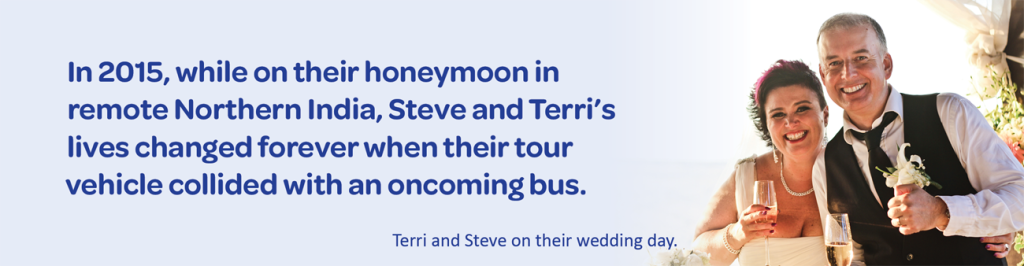
With no ambulance or hospital nearby, the situation was dire. Terri was knocked unconscious on impact, suffering catastrophic injuries to her skull and body, including multiple fractures and a traumatic brain injury. Believing he had lost her, Steve—miraculously uninjured—held Terri’s head stable in his lap as a local man helped transport them in the back of a ute. For three long hours they travelled along rough, isolated roads to the nearest medical centre, each jolt potentially worsening Terri’s already critical condition.
Terri was stabilised at a hospital in India before being airlifted home to Australia. Though she had numerous physical injuries, the most devastating was her closed head injury: her brain had shifted inside her skull, causing severe swelling and life-threatening pressure. With limited options available, doctors could only work to reduce the swelling, lower the pressure, and monitor her minute by minute.
We NEED your help to fund crucial game changing research into treating traumatic brain injury.
Her prognosis was uncertain and grim. The severity of her brain trauma meant doctors could not say whether Terri would ever wake, or—if she did—whether she would regain any meaningful function. She remained in a coma for two months. When she finally opened her eyes, she entered a period of post-traumatic amnesia.
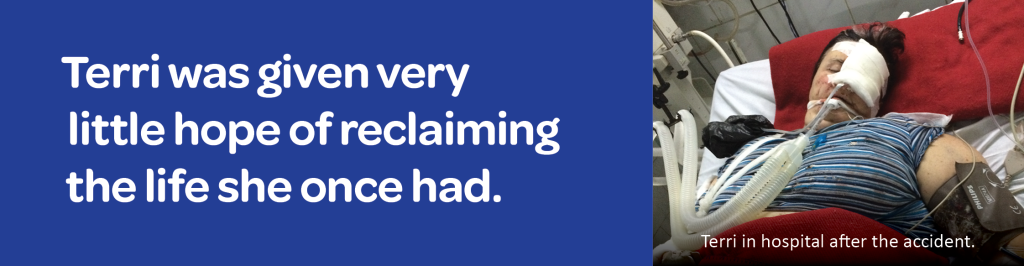
But with extraordinary determination, the unwavering support of her devoted husband Steve (who is also her carer), and the dedication of her medical team, Terri defied every expectation. After a long and difficult rehabilitation journey, she regained the ability to speak, make decisions, eat independently, and has even returned to work. Still, the accident left lasting and life-altering effects. Terri now requires 24-hour care, cannot be left alone, uses a wheelchair, and continues to manage multiple chronic health conditions—some of which have been life-threatening.
“If you have everything taken away, what else do you have to lose. Life is precious. Help us to save other people’s lives.” – Steve Wales
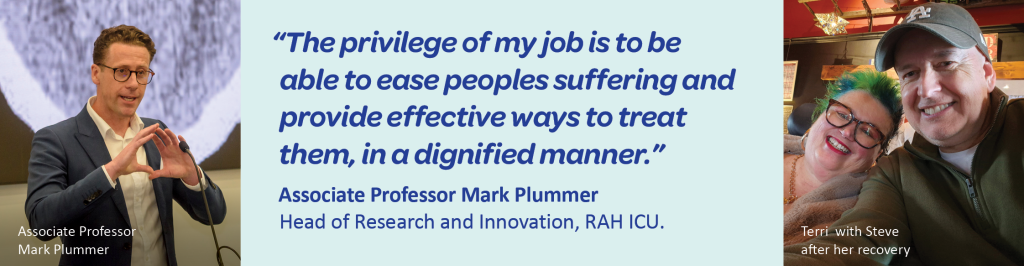
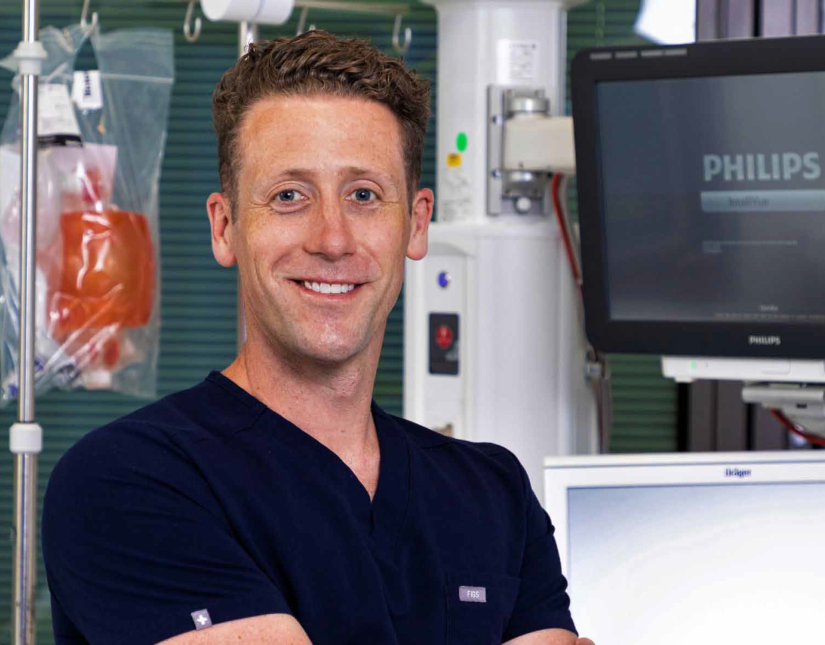
Fast forward 15 years to Royal Adelaide Hospital (RAH), where Associate Professor Mark Plummer – Head of Research and Innovation, RAH Intensive Care Unit (ICU) – has developed a potentially game changing approach to how traumatic brain injury patients in ICU can be treated.
As you may have read in our Newsletter, Associate Professor Mark Plummer is genuinely excited about this prospective treatment that uses high dose levels of a drug similar to Vitamin C to treat traumatic brain injury.
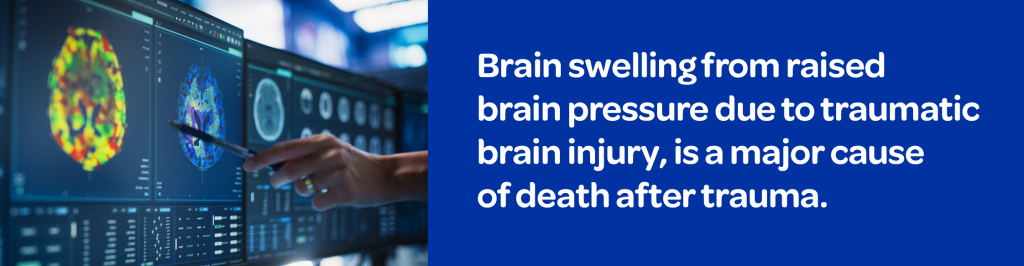
When pressure in the brain goes up—like after a head injury, stroke, or infections such as meningitis—it causes dangerous swelling. That swelling often leads to patient death or disability. Detecting and treating brain swelling quickly is critical to improved patient outcomes.
Your donation will help!
The current standard of care uses concentrated saline—essentially large doses of table salt dissolved in water—to dehydrate the brain. While the sodium component is fine, the chloride can be harmful.
This new line of research from Mark and his team focuses on using high levels of a new drug related to Vitamin C, to treat the swelling in the brain after traumatic brain injury. Vitamin C is a potent antioxidant, and the brain is unique in how strongly it concentrates vitamin C compared to other tissues. After a traumatic brain injury, vitamin C levels in the brain plummet and this deficiency may worsen the damage.
Mark’s research has shown that this new drug that is similar to vitamin C reduces brain pressure even better than the salty water doctors currently use. This could be extremely beneficial to how traumatic brain injury patients are treated and recover worldwide.
Surprisingly, no other research groups worldwide are working on this right now. This is truly a unique South Australian (SA) born idea, right in the home of SA, at Royal Adelaide Hospital!
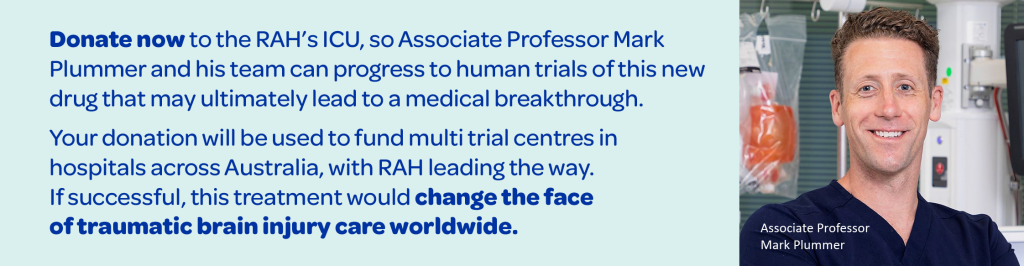
So, when people like Terri enter the ICU with traumatic brain injury and require lifesaving help from doctors like Mark, the outcomes of being treated to live a disability free life will be raised enormously if this trial is tested and approved.
Would Terri’s journey and health post coma have been positively impacted by Mark’s treatment, if it was available at the time?
The answer is Yes.
Terri’s recovery would have been quicker, she would have regained more function of her body in a shorter time, and it would have made her recovery journey much easier, had treatment like Mark Plummer’s been up and running at the time of her incident. Steve, Terri’s devoted husband and carer, strongly believes her outcomes would have been improved.
Donate now and you will power this South Australian born innovation that has the potential to change the lives of the many traumatic brain injury patients that are admitted to Intensive Care Units Australia wide, every year.
Traumatic brain injury facts:
- The two leading causes of severe traumatic brain injury are falls and transport related injuries
- In Australia over 3000 patients are admitted to ICU every year with a traumatic brain injury
- New cases of traumatic brain injury add $2 billion in direct lifetime costs to the Australian health system every year
- Traumatic brain injury is the leading cause of death and severe cause of disability, with a mortality rate of 1 third
You have the facts.
Now, YOU have the POWER to change this.
YOU have the POWER to help.