


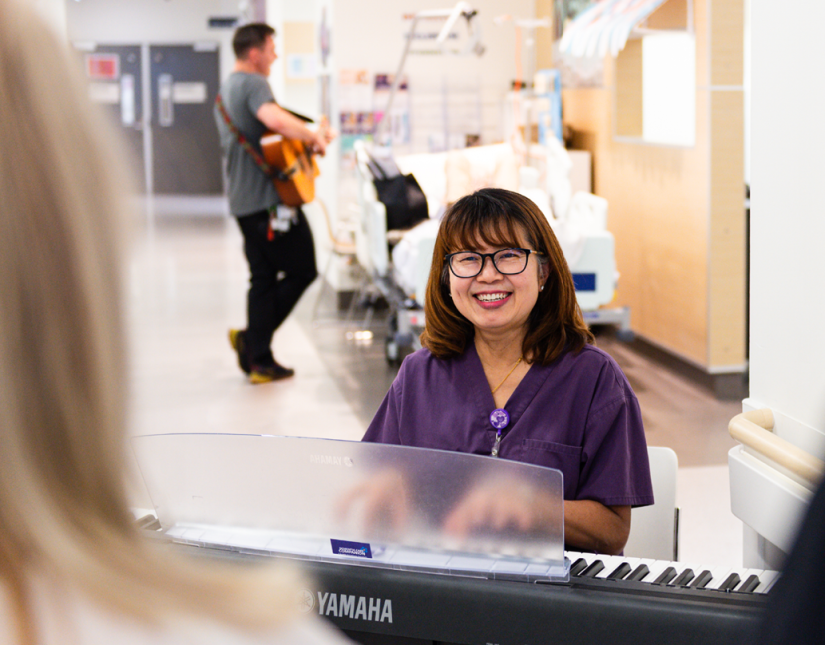
An inside view of Music Therapy Research at the Royal Adelaide Hospital.
The power is in YOUR hands, please help fund Music Therapy RESEARCH today.
As you may have read in our Autumn Newsletter, Dr. Patsy Tan is a senior RAH Music Therapist and Researcher whose role is currently funded by THRFG (The Hospital Research Foundation Group).
Somewhere in the RAH ward, Dr. Patsy Tan is in the final stage of completing a Heartbeat project for a palliative care inpatient. Using a special stethoscope purchased via donations for Music Therapy Research via the Royal Adelaide Hospital Research Fund, the patient’s heartbeat is recorded and integrated into a musical composition which is then personalized by Dr. Patsy Tan and the patient. The Heartbeat project is available to palliative care patients facing probable end-of-life and is a delicate and unique forever keepsake for the family to take home.
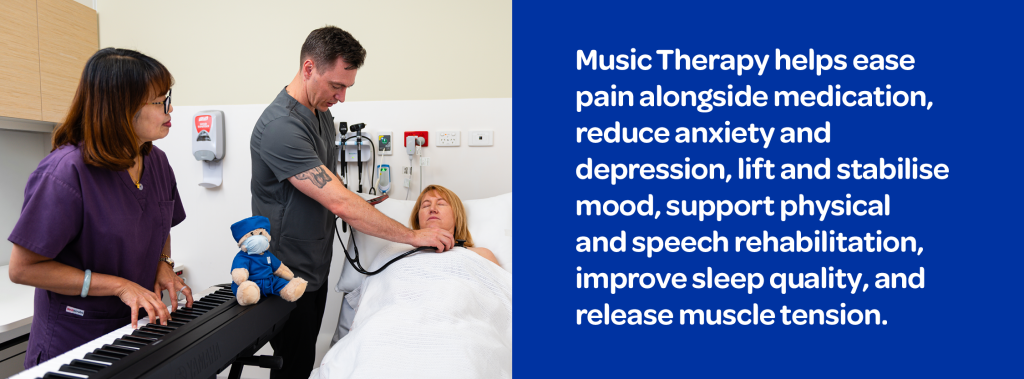
Music therapy offers evidence-based benefits for mental, physical, and cognitive health by reducing stress, anxiety, and depression while simultaneously improving mood. It is used to enhance a patient’s communication, memory, and motor skills and has been found to be a particularly effective therapy tool in patients with Alzheimer’s or stroke.
The Heartbeat Project is a true testament to the power of music therapy. You can pioneer music therapy research at YOUR RAH by donating today!
Please donate TODAY to Music Therapy Research!
“During my mother’s palliative care, we experienced music therapy, and it was a profound gift for both her and our family. We are deeply grateful to Dr. Patsy Tan for bringing comfort when nothing else could, easing pain, softening fear, and creating moments of peace amid illness and uncertainty. When the music began, we saw Mum’s face relax for the first time in days, it felt like she was finally at peace. Music became our way to connect when words were no longer possible. We sat together, holding hands, listening to her favourite songs. Patsy even researched and performed Mum’s favourite traditional Italian music, playing and singing it for her. She gave us moments and memories we will carry forever, reminding us that even at the end of life, there can be beauty, connection, and profound human tenderness.”
Anonymous quote from family of palliative care patient who experienced Dr. Patsy Tan and her music therapy at RAH.
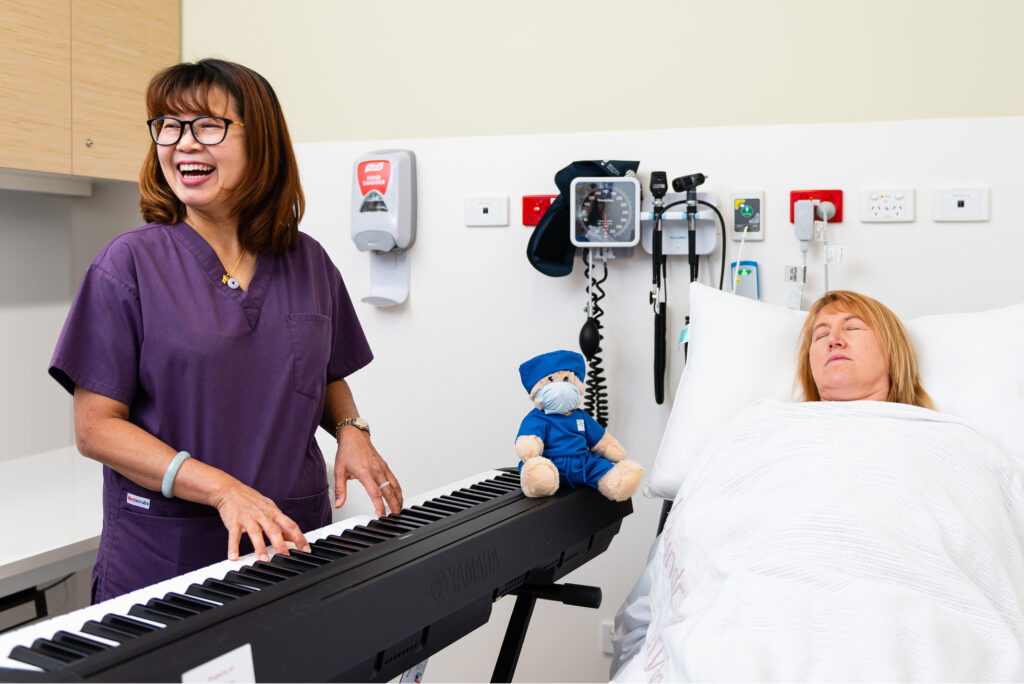
Dr. Patsy Tan
Stroke Patients and Music Therapy Research at RAH
In addition to the Heartbeat project, Dr. Patsy Tan has many music therapy projects at RAH. One project requiring funding is MIT (Melodic Intonation Therapy) for stroke patients.
MIT is a research-supported speech treatment for stroke patients with non-fluent (expressive) aphasia. MIT uses singing and rhythmic tapping to stimulate the undamaged right hemisphere of the brain, assisting the damaged left-hemisphere language centers to improve expressive language functions. This therapy helps patients transition from singing to speaking phrases, often improving conversational speech and verbal output. As you can imagine, going from non-verbal to verbal via singing is life changing for stroke patients who have already had their life altered in a vast way.
Currently stroke patients receive stage 1 of treatment at RAH. They are transferred to TQEH to participate in the stroke choir for stage 2 of treatment. This is where MIT takes place. MIT is one of the few accepted treatments for severe non-fluent aphasia. What is considered a positive outcome of MIT is defined as an improvement in conversational speech skills.
Please donate TODAY to Music Therapy Research!
Improving conversational speech skills can be achieved through the establishment of a choir. Patients will use the choir as part of their singing therapy, activating the right hemisphere of their brain, hence regaining verbal speech. The stroke choir set up at TQEH in affiliation with the RAH, is in the new stages of establishment and requires funding for speech therapists and trained singers to work with the stroke patients. The goal is to achieve conversational verbal speech through singing (MIT).
Regaining speech is a lengthy and complex process involving numerous qualified therapists in addition to our Music Therapists’ support. There are elementary, intermediate, and advanced levels and procedures in MIT that require different types of support. With your generous help today, many stroke patients will regain their speech and be able to freely communicate with their loved ones again.
You have the opportunity to help stroke patients find their voices again by supporting Music Therapy Research! Donate now.
Please donate TODAY to Music Therapy Research!